

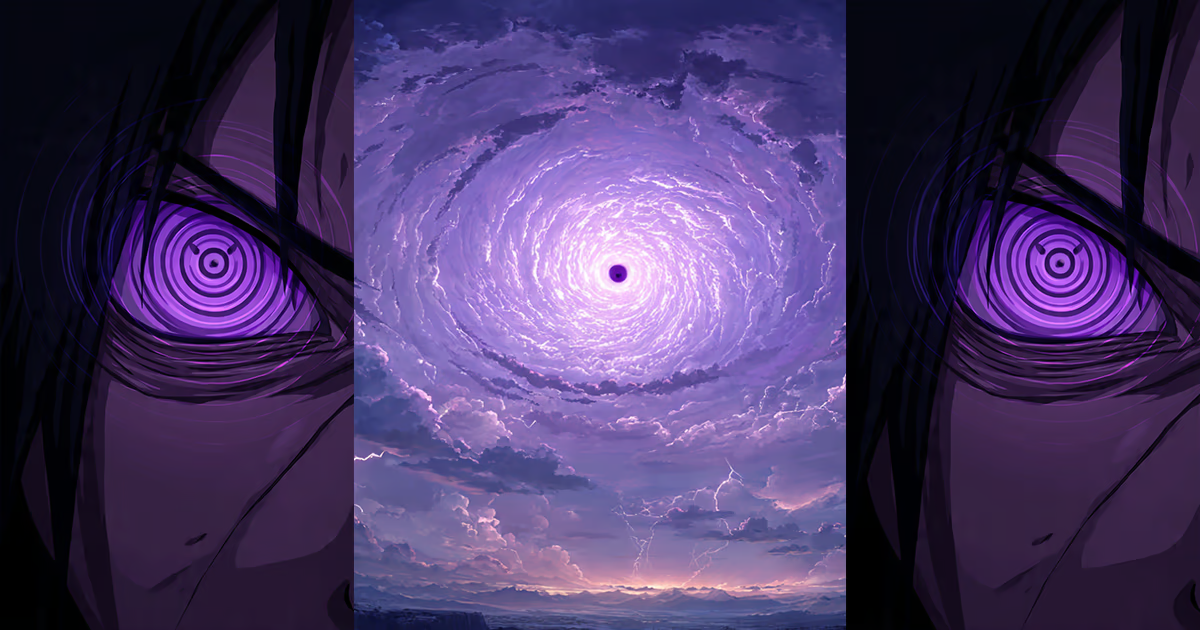
The Rinnegan stands as the most legendary and feared dojutsu in the Naruto universe, a mystical eye technique that grants its wielders powers rivaling those of the gods themselves. With its distinctive purple iris marked by concentric ripple patterns, this ocular ability represents the pinnacle of ninja evolution and the bridge between mortal limitations and divine intervention. Throughout the series, the mere mention of the Rinnegan sends shivers through even the most powerful shinobi, as its appearance often signals world-altering events.
Unlike other dojutsu that enhance specific abilities or provide tactical advantages, the Rinnegan fundamentally transforms its user into a force of nature capable of reshaping reality itself. From controlling gravity and manipulating souls to summoning mythical creatures and wielding the power of creation and destruction, this eye technique transcends conventional understanding of what ninja arts can achieve. The Rinnegan’s emergence in the story marks pivotal moments where the fate of entire nations—and indeed the world—hangs in the balance.
What is the Rinnegan?
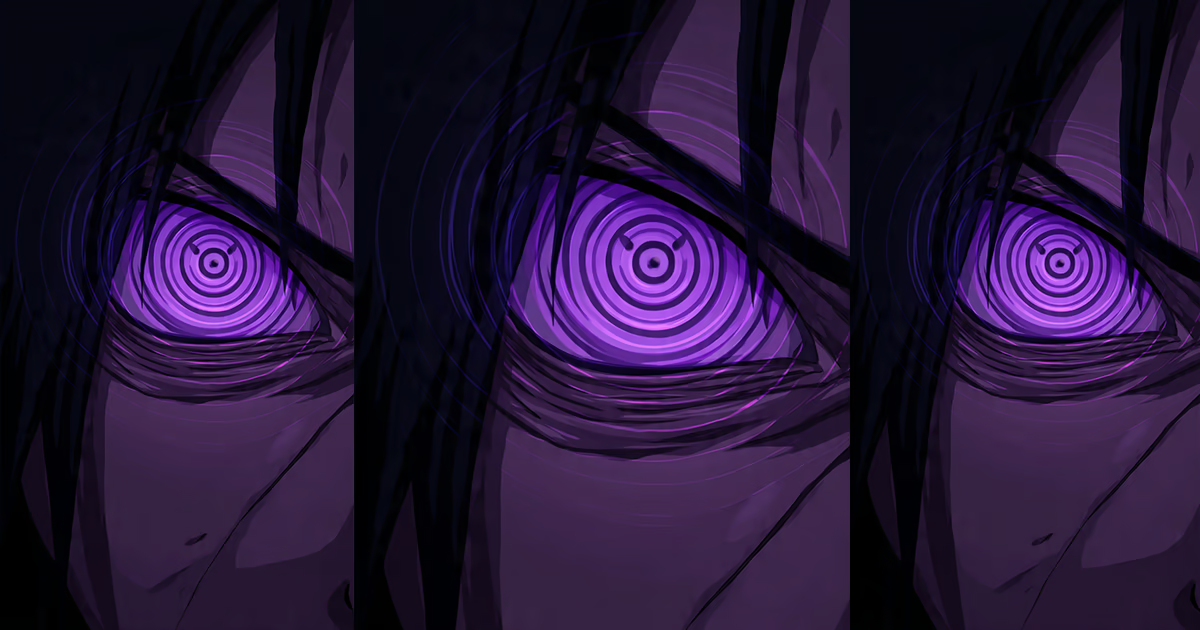 The Rinnegan represents the most advanced form of dojutsu known to exist within the Naruto universe, distinguished by its unmistakable appearance of purple-colored eyes containing multiple concentric circles that ripple outward from the pupil. This legendary ocular power is fundamentally different from other eye-based abilities like the Sharingan or Byakugan, as it grants access to all five basic nature transformations simultaneously while unlocking abilities that defy natural laws.
At its core, the Rinnegan embodies the concept of transmigration and the cyclical nature of existence, drawing its name from the Buddhist concept of samsara—the endless cycle of death and rebirth. This philosophical foundation manifests in the technique’s most signature ability: the Six Paths of Pain, which allows the user to manipulate fundamental forces including attraction, repulsion, mechanical augmentation, soul extraction, summoning, and the power over life and death itself.
The origins of the Rinnegan trace back to the Sage of Six Paths, Hagoromo Otsutsuki, who first manifested this power and used it to bring peace to a war-torn world. According to official Naruto canon, the Rinnegan emerges only under extraordinary circumstances, typically requiring the combination of Indra and Asura’s chakra—representing the two fundamental aspects of the Sage’s power that were split between his sons.
What sets the Rinnegan apart from other dojutsu is its comprehensive nature. While the Sharingan excels in perception and copying techniques, and the Byakugan provides enhanced vision and chakra sight, the Rinnegan encompasses these abilities while adding unprecedented creative and destructive powers. Users can absorb and nullify ninjutsu, create black receivers that disrupt chakra flow, and even manifest additional limbs or weapons from their body.
The technique’s most terrifying aspect lies in its Outer Path ability, which grants dominion over life and death. This power enables users to revive the deceased, extract souls from living beings, and summon the Demonic Statue of the Outer Path—a creature of immense power that serves as the empty vessel for the Ten-Tails. Through documented instances in the series, we observe how this ability transforms conflicts from mere physical confrontations into metaphysical battles for the very essence of existence.
Origins and Mythology of the Rinnegan
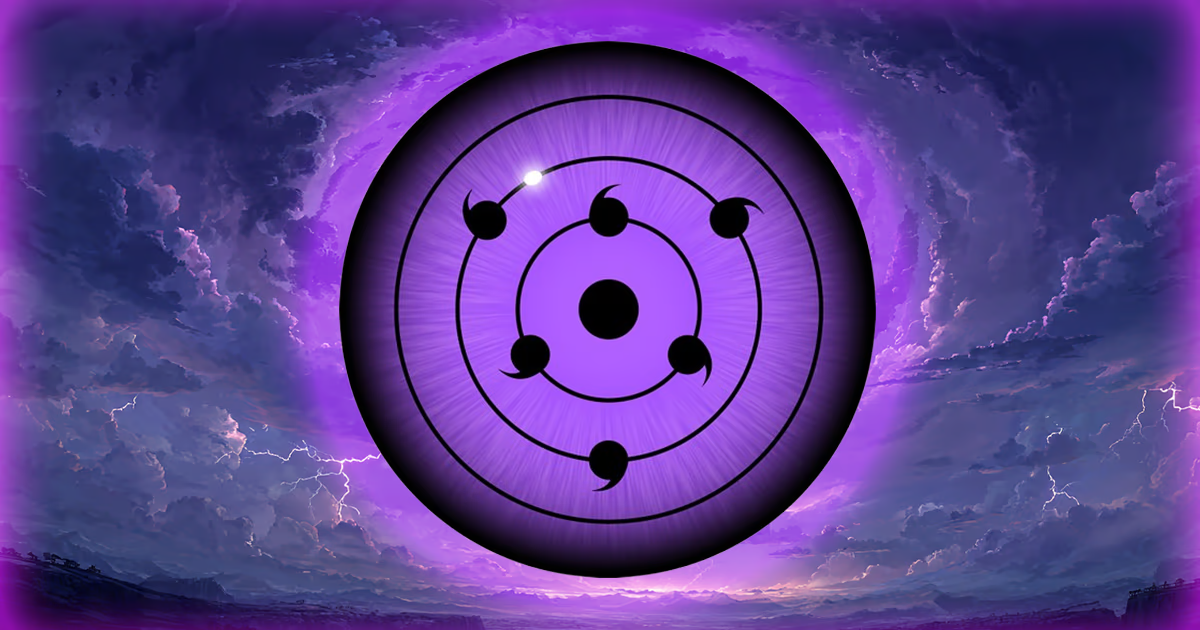 The Rinnegan’s origins trace back to the most fundamental creation myths within the Naruto universe, establishing it as humanity’s first and most powerful ocular jutsu. According to ancient texts and historical accounts revealed throughout the series, the Rinnegan first manifested in Hagoromo Ōtsutsuki, known posthumously as the Sage of Six Paths, following his consumption of the Divine Tree’s fruit alongside his mother, Kaguya Ōtsutsuki.
The mythological significance of the Rinnegan extends far beyond its mere appearance as a powerful dōjutsu. Ancient shinobi folklore describes these legendary eyes as the harbinger of both creation and destruction, capable of bringing forth life from nothingness or reducing entire landscapes to dust. The concentric ring pattern that characterizes the Rinnegan was interpreted by early civilizations as representing the eternal cycle of samsara—birth, death, and rebirth—a concept that would later prove prophetic given the technique’s ultimate ability to resurrect the dead through the Rinne Rebirth jutsu.
Historical documentation suggests that after Hagoromo’s death, knowledge of the Rinnegan became fragmented and mythologized across different regions. Various ninja clans developed their own interpretations of the legendary eyes, with some viewing them as divine gifts meant to guide humanity toward peace, while others saw them as cursed relics that brought only suffering to their wielders. These conflicting beliefs created a complex tapestry of legends that would influence shinobi culture for centuries.
The Sage of Six Paths himself recognized the profound responsibility that came with possessing the Rinnegan. Before his death, Hagoromo established the foundation of ninshu—the precursor to modern ninjutsu—believing that the power of the Rinnegan should serve to connect people rather than divide them. This philosophical approach to the Rinnegan’s capabilities would later become central to understanding why certain individuals could awaken these eyes while others could not.
Archaeological evidence within the series indicates that knowledge of the Rinnegan’s true nature was deliberately obscured over time. The Buddhist concepts of enlightenment and suffering heavily influenced how ancient shinobi interpreted the Rinnegan’s abilities, particularly the Six Paths of Pain technique. Each path represented different aspects of existence—from the animal realm to the human realm—reflecting deep philosophical understanding of consciousness and reality.
Perhaps most significantly, the original mythology established the Rinnegan as a bridge between the physical and spiritual worlds. This connection would prove crucial in later conflicts, as the technique’s ability to manipulate life and death energies stemmed directly from its origins in the Divine Tree—the same source that would eventually spawn the tailed beasts and fundamentally alter the balance of power in the ninja world.
How to Awaken the Rinnegan
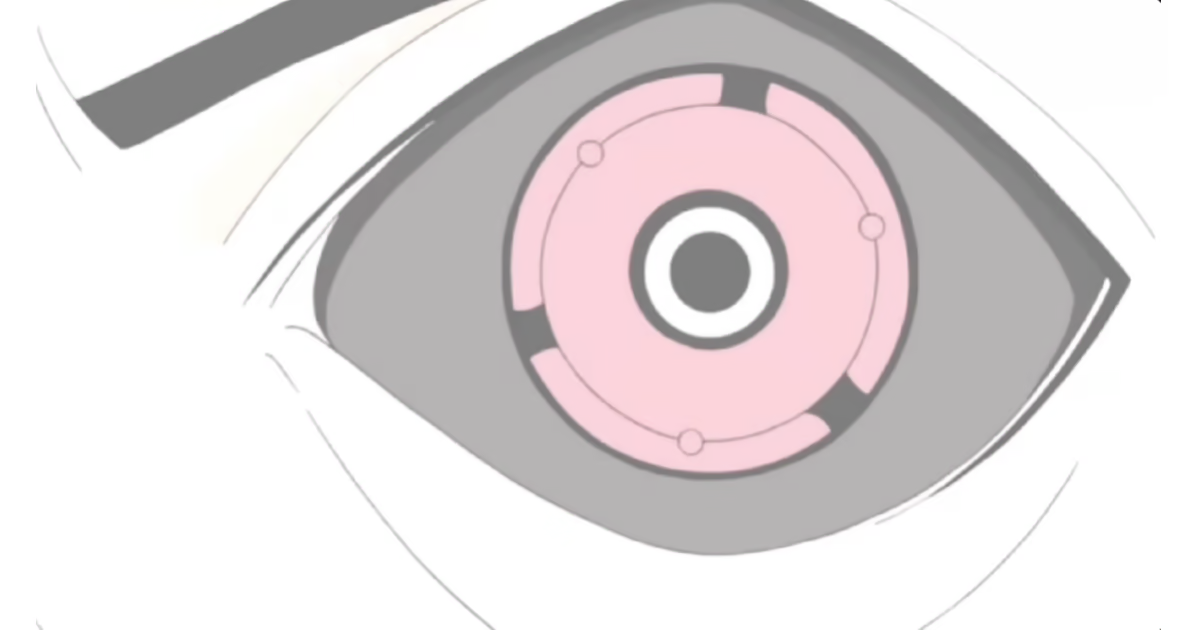 The awakening of the Rinnegan represents one of the most complex and demanding processes in the entire Naruto universe, requiring specific bloodline prerequisites and extraordinary circumstances that few shinobi could ever hope to achieve. Unlike other dojutsu that can be transplanted or inherited through direct lineage, the natural manifestation of the Rinnegan demands a perfect convergence of genetic heritage and chakra manipulation that borders on the mythical.
The primary requirement for Rinnegan awakening centers on possessing chakra from both Ashura and Indra Otsutsuki, the legendary sons of the Sage of Six Paths. This means that only individuals who are reincarnations of these ancient beings, or those who can somehow combine their respective chakra signatures, have any realistic chance of manifesting this ultimate eye power. Throughout the series, this has been demonstrated most clearly through Madara Uchiha’s journey, where he combined his own Indra chakra with cells from Hashirama Senju, who carried Ashura’s chakra signature.
The awakening process itself typically requires decades of preparation and extraordinary circumstances. Madara’s experience illustrates the lengthy timeline involved – he implanted Hashirama’s cells into his body but didn’t awaken the Rinnegan until near the end of his natural life. This suggests that the fusion of opposing chakra natures requires extensive time for proper integration and maturation within the recipient’s system. The process appears to be gradual rather than instantaneous, with the body slowly adapting to accommodate the massive power surge that accompanies Rinnegan manifestation.
Emotional trauma and extreme psychological states often serve as catalysts for the final awakening phase. Manga narratives frequently employ intense emotional triggers for power evolution, and the Rinnegan follows this pattern. The combination of life-threatening situations, profound loss, or the approach of death creates the psychological conditions necessary for the dormant power to emerge. This emotional component explains why the awakening cannot be artificially rushed or forced through purely technical means.
Alternative methods exist but remain extremely limited and controversial within the shinobi world. Direct transplantation from an existing Rinnegan user represents the most straightforward approach, though it requires killing or severely injuring someone who already possesses the eyes. This method bypasses the natural requirements but comes with significant drawbacks, including reduced power efficiency and potential rejection by the recipient’s body. Additionally, genetic compatibility remains crucial even for transplantation success, limiting this option to individuals with appropriate bloodline connections.
The rarity of natural Rinnegan awakening cannot be overstated – across centuries of shinobi history, only a handful of individuals have achieved this transformation through legitimate means, making it perhaps the most exclusive power in the entire ninja world.
Six Paths of Pain Abilities
 📷 six paths pain rinnegan users
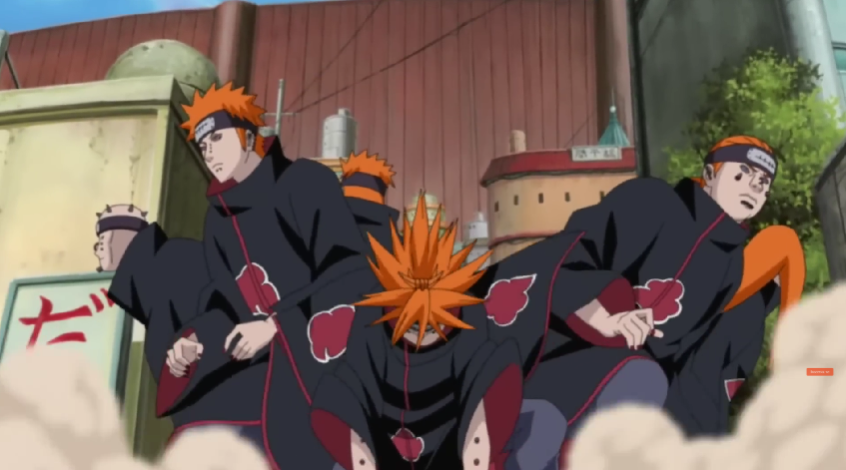
The Six Paths of Pain represent one of the most devastating applications of the Rinnegan’s power, allowing the user to control up to six separate bodies simultaneously while granting each one a unique supernatural ability. This technique transforms the battlefield into a coordinated assault zone where each path complements the others, creating an nearly insurmountable combat advantage through diversified attacks and strategic positioning.
The Deva Path stands as the most formidable among the six, wielding gravitational manipulation that can attract or repel any object or person with tremendous force. This path’s signature technique, Shinra Tensei, creates an omnidirectional repulsive force capable of leveling entire villages, while Bansho Tenin draws targets irresistibly toward the user. The gravitational control extends to flight capabilities and the creation of miniature planetary cores, making the Deva Path a versatile tool for both offensive strikes and defensive maneuvers.
The Asura Path transforms its body into a mechanical arsenal, sprouting additional arms, missile launchers, and blade weapons from various body parts. This cybernetic enhancement allows for overwhelming firepower and close-quarters combat superiority, with the ability to detach and regenerate limbs at will. The mechanical modifications provide enhanced physical strength and the capacity to unleash devastating explosive attacks that can obliterate multiple opponents simultaneously.
Operating in the realm of souls and life force, the Human Path possesses the terrifying ability to extract information directly from a target’s mind before ripping out their soul, resulting in instant death. This interrogation technique proves invaluable for intelligence gathering, though the fatal consequence limits its strategic applications. The soul extraction bypasses all physical defenses, making it one of the most feared abilities among the Six Paths arsenal.
The Animal Path specializes in summoning a vast array of creatures, from giant multi-headed dogs to enormous birds and rhinoceros-like beasts. Each summoned creature shares the Rinnegan’s visual field, creating an extensive surveillance and combat network. These summons can multiply when destroyed and serve multiple tactical purposes, from reconnaissance missions to overwhelming numerical advantages in battle.
The Preta Path functions as the ultimate defensive measure, absorbing any chakra-based attack and converting it into the user’s own energy. This nullification ability renders most ninjutsu completely ineffective while simultaneously strengthening the user’s chakra reserves. The absorption capability extends to sustained contact, allowing the Preta Path to drain opponents through direct physical touch.
Finally, the Naraka Path controls the King of Hell, a massive spectral judge that can interrogate victims and restore destroyed Pain bodies to full functionality. This resurrection ability ensures the Six Paths maintain their numerical advantage throughout extended conflicts, while the interrogation function provides another avenue for extracting crucial information from captured enemies.
Rinnegan vs Sharingan: Power Comparison
The debate between Rinnegan and Sharingan superiority has captivated Naruto fans for years, with both dojutsu representing pinnacles of ocular power yet serving fundamentally different purposes in combat and strategy. While the Sharingan excels in tactical applications and rapid adaptation, the Rinnegan dominates through sheer destructive potential and reality-altering capabilities.
In terms of raw power output, the Rinnegan significantly outclasses the Sharingan through its Six Paths techniques. The ability to manipulate gravity via Deva Path, absorb any ninjutsu through Preta Path, and summon powerful creatures via Animal Path provides users with versatile offensive and defensive options that exceed what even the Mangekyo Sharingan can offer. Pain’s devastation of Konoha Village through Shinra Tensei demonstrates the Rinnegan’s capacity for large-scale destruction that no Sharingan technique has matched in scope.
However, the Sharingan maintains distinct advantages in precision and predictive capabilities. Its three-tomoe form grants users enhanced perception, allowing them to track high-speed movements and copy techniques with remarkable accuracy. The precognitive abilities enable Sharingan users to anticipate and counter opponents’ actions before they fully manifest, providing a tactical edge that pure power cannot replicate. Additionally, genjutsu mastery through Sharingan creates psychological warfare opportunities that complement physical combat strategies.
The evolutionary paths of both dojutsu reveal contrasting philosophies of power acquisition. Sharingan develops through emotional trauma and combat experience, with each tomoe representing growth through adversity. The Mangekyo Sharingan’s awakening requires profound loss, typically involving close relationships, making its power inherently tied to personal sacrifice. Conversely, Rinnegan manifests through combining Indra and Asura’s chakra, representing unity rather than trauma-induced evolution.
Chakra consumption patterns differ dramatically between the two dojutsu. Sharingan users, particularly those without Uchiha bloodline, experience rapid chakra depletion, as demonstrated by Kakashi’s limitations before acquiring Hashirama cells. Rinnegan users face similar challenges, but the techniques’ overwhelming power often compensates for the energy expenditure. Nagato’s physical deterioration from Rinnegan usage illustrates the toll of wielding such immense power without proper constitution.
Strategic versatility represents another crucial comparison point. Sharingan users excel in adaptation and technique mimicry, making them formidable against diverse opponents through accumulated knowledge and copied abilities. Rinnegan users possess inherent versatility through the Six Paths, requiring less adaptation but offering more specialized roles in combat scenarios. The Rinnegan’s ability to revive the dead through Outer Path ultimately positions it as the superior dojutsu for large-scale conflicts and world-altering events.